Grandma Took The Art Room
The Key In Her Hand
I came home two hours early because a client cancelled dinner and the rain made traffic move like poured glue. I remember feeling grateful for the quiet. I thought I might surprise Emma with takeout and a movie.
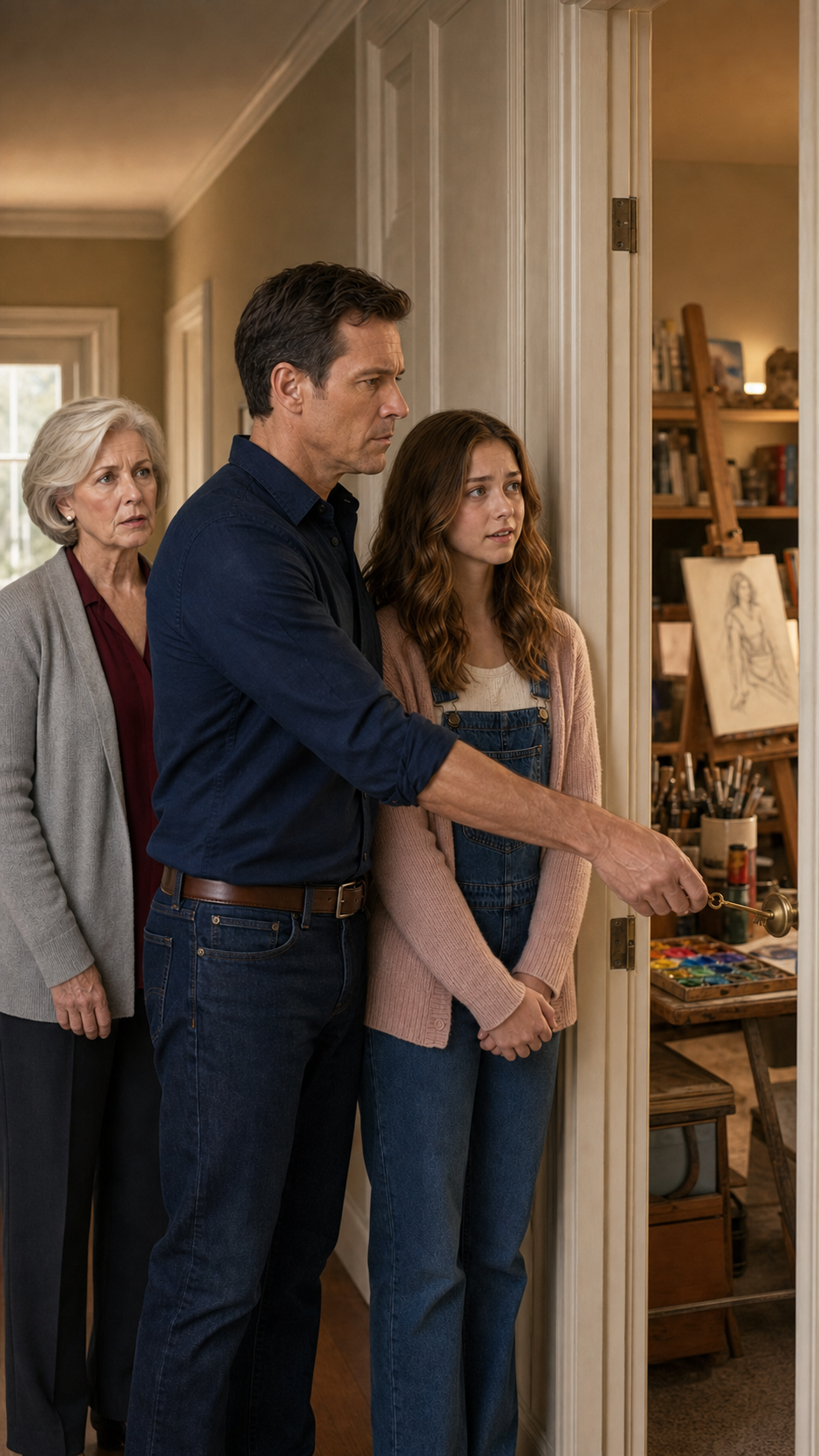
Instead, I found my fourteen-year-old daughter standing in the upstairs hallway with her sketchbook pressed flat against her chest.
Emma did not run to me. She did not smile. She stood outside her art room with both hands folded around that sketchbook like she had been called to the principal's office.
My mother stood beside the closed white door.
In her right hand was a brass key.
"Dad," Emma said softly, "Grandma says the room is not mine anymore."
For a second, I thought I had misunderstood. The room had a crooked wooden sign on the door that Emma painted last summer. Emma's Studio. Blue letters. Yellow stars. One smudge where she had cried laughing because the paint ran.
That room was not just space. It was the first place Emma had slept with the light off after her mother left.
"Mom," I said, keeping my voice even, "why do you have Emma's key?"
My mother looked at me as if I was the one creating a scene.
"Because this room is being used properly now."
Properly was one of her old words. It meant cleaned, controlled, and arranged around her comfort.
"Open the door," I said.
She tightened her fingers around the key. "David, do not undermine me in front of a child."
"She is my child."
"And I am the adult here when you are gone."
Emma's eyes dropped to the floor.
That small movement hit me harder than my mother's words.
I looked at Emma. "Has she said that before?"
Emma's mouth opened, then closed.
My mother answered for her. "She is dramatic. Teenagers are dramatic."
Then Emma whispered, so quietly I almost missed it, "She says it every day."
The pressure did not disappear when this moment ended. I came home two hours early and found my daughter standing outside the room I had promised would always be hers.
Every person in the room carried away a different version of what had happened. The truth was still incomplete, but the smallest details had begun to connect.
By the time the next decision arrived, the family could no longer rely on silence to protect its oldest secret.
Used Properly
I held out my hand for the key.
My mother did not move. Her face had settled into the expression I remembered from childhood, the one that said the conversation was over because she had decided it was over.
"You are tired," she said. "We can discuss this after dinner."
"The key, Mom."
Emma stood so still beside the wall that I could hear the rain tapping the window behind her.
My mother placed the key in my palm like she was returning something borrowed from a careless man.
I opened the door.
The room inside looked half familiar and half stolen.
Emma's easel still stood by the window, but the canvas on it had been turned backward. Her shelves were no longer filled with sketchbooks and charcoal tins. They held teacups, folded tablecloths, and three cardboard boxes labeled Friday Bridge.
A folding chair sat in the center of the rug. My mother's reading lamp had been dragged in from the guest room. Her purse rested on Emma's paint stool.
Emma stepped to the doorway and stopped.
"Where are your paintings?" I asked.
"Garage," she said.
"All of them?"
She nodded once.
My mother sighed. "They were cluttering the room. I needed somewhere respectable for my guests."
"Your guests?"
"My book club is coming Friday. These women should not have to sit in the kitchen like delivery people."
Emma's cheeks flushed red.
I walked to the corner and lifted one of the tablecloth boxes. Under it was a flattened sketchbook. The cover was bent. A page corner was torn where someone had shoved it under cardboard.
"It is only paper," my mother said.
Emma flinched.
That was the second time in less than five minutes that my daughter reacted like she had already learned not to defend herself.
I set the box down carefully because my hands were starting to shake.
The pressure did not disappear when this moment ended. The room had not been borrowed for one afternoon. It had been taken apart while I was at work.
Every person in the room carried away a different version of what had happened. The truth was still incomplete, but the smallest details had begun to connect.
By the time the next decision arrived, the family could no longer rely on silence to protect its oldest secret.
The Garage
The garage smelled like wet cardboard and old paint.
Emma followed me halfway down the stairs, then stopped on the landing. My mother followed both of us, speaking in that low polished voice she used when she wanted witnesses to think she was calm.
"David, you are making this ugly."
"No," I said. "I am finding out how ugly it already got."
Emma's canvases were stacked behind the recycling bins.
Not placed. Stacked.
One frame had cracked at the corner. Another canvas had a gray shoe print across the protective paper. A box of brushes sat open on the concrete, several bristles bent sideways from being crushed under a storage tote.
Emma made a sound behind me, small and broken.
I turned, but she had already covered her mouth.
My mother looked at the pile. "She has too many. No child needs this much nonsense."
"Stop calling it nonsense."
"Then stop treating it like a medical device."
That sentence told me she remembered exactly why the room mattered.
After the divorce, Emma had stopped speaking at school for three weeks. Her counselor told me to give her a place where nothing had to be explained before it could exist.
So I made the art room.
My mother had sat at my kitchen table and nodded through that explanation. She had said, poor thing, children need stability.
Now she had put that stability in the garage.
I lifted the top canvas. It was a painting of a hallway. A girl stood outside a door. An older woman stood inside the doorway holding a key.
The girl in the painting had no mouth.
Emma whispered, "I wasn't going to show you that one."
I looked from the painting to my mother.
My mother said nothing.
For once, that scared me more than her excuses.
The pressure did not disappear when this moment ended. When I opened the garage, I understood that this had not been a misunderstanding. It had been a campaign.
Every person in the room carried away a different version of what had happened. The truth was still incomplete, but the smallest details had begun to connect.
By the time the next decision arrived, the family could no longer rely on silence to protect its oldest secret.
The Camera
I installed the hallway camera six months earlier after packages started disappearing from the porch.
It pointed at the stairs, not inside any room. I had forgotten it even recorded audio until Emma looked at it and turned pale.
"What is it?" I asked.
"Nothing."
My mother answered too fast. "You do not need to drag machines into family matters."
That was when I knew I did.
I opened the app on my phone.
My mother stepped toward me. "David."
"Don't."
The first clip was from Tuesday afternoon. Emma stood outside the art room holding a pencil case. My mother stood in the doorway with the key.
On the video, Emma said, "Dad said this is my room."
My mother's voice came through clear and sharp.
"Your father says many things when he wants to feel like a good parent."
Emma's shoulders folded inward.
The next clip was Wednesday.
Emma asked if she could get her sketchbook before school. My mother told her no. Emma said there was homework inside. My mother replied, "Then you should have thought of that before you made such a mess."
The third clip was worse.
My mother stood close enough to the camera that I could see the pearl earring at her neck.
"When your father is gone," she said, "I am in charge. If you complain again, I will tell him you are becoming unstable like your mother."
The hallway went silent.
In the present, Emma started crying without making a sound.
My mother looked at me as if the video had betrayed her.
The pressure did not disappear when this moment ended. The hallway camera was supposed to help me check deliveries. It showed me what my daughter had been afraid to say.
Every person in the room carried away a different version of what had happened. The truth was still incomplete, but the smallest details had begun to connect.
By the time the next decision arrived, the family could no longer rely on silence to protect its oldest secret.
Unstable
Unstable.
That was the word my mother used after Claire left us.
Not grieving. Not overwhelmed. Not sick. Unstable.
She said it at the custody hearing. She said it to relatives. She said it quietly to neighbors when they asked why Emma spent weekends with me and not her mother.
Claire had not left because she stopped loving Emma. She left because depression swallowed her after the divorce and she checked herself into treatment before it swallowed our daughter too.
Emma knew only pieces. Enough to miss her mother. Enough to be afraid that sadness could be used against a person.
My mother knew that too.
I paused the video and looked at her.
"You threatened her with her mother."
"I warned her about behavior."
"You used the one thing she is most afraid of."
My mother lifted her chin. "Someone had to keep order while you were busy pretending work was parenting."
The sentence landed because part of it was true. I had been busy. I had been tired. I had accepted Emma's quiet as peace because peace was easier to come home to.
But my guilt did not make my mother right.
I saved the clips to my phone.
My mother's face changed. It was quick, but I saw it.
Fear.
"Who are you sending those to?" she asked.
"No one yet."
"David, family does not record family."
"Family does not make a child afraid to speak in her own house."
Emma wiped her face with her sleeve.
Then she said, "There is something else."
The pressure did not disappear when this moment ended. My mother had not only taken a room. She had learned which word would scare my daughter into silence.
Every person in the room carried away a different version of what had happened. The truth was still incomplete, but the smallest details had begun to connect.
By the time the next decision arrived, the family could no longer rely on silence to protect its oldest secret.
The Envelope
Emma led me to the guest room.
My mother moved faster than I had seen her move since the fall. "Absolutely not. That is my private space."
"You searched mine," Emma said.
It was the first full sentence she had aimed directly at my mother all afternoon.
My mother stopped.
Emma pointed at the bedside drawer. "She keeps an envelope there. I saw my school name on it."
I opened the drawer.
The envelope was under a stack of appointment reminders. It was addressed to North Ridge Preparatory Academy, a boarding school three states away.
Inside was an application packet.
Most of it had already been filled out.
Emma's name. Emma's birth date. My address. My signature line left blank.
Attached to the packet was a typed statement.
The child has become emotionally dependent on fantasy activities and resists adult authority in the home.
Fantasy activities.
She meant painting.
I read the next line twice because my brain refused to accept it.
A structured residential environment may be necessary if her father continues enabling the behavior.
Emma stood beside me, white-faced.
"Were you going to send her away?" I asked.
My mother pressed her lips together.
"I was going to save her from becoming Claire."
Something in me went cold.
"Pack your things," I said.
"David."
"Tonight."
The pressure did not disappear when this moment ended. The thing hidden under my mother's mattress was not about a room. It was about taking Emma out of the house entirely.
Every person in the room carried away a different version of what had happened. The truth was still incomplete, but the smallest details had begun to connect.
By the time the next decision arrived, the family could no longer rely on silence to protect its oldest secret.
The Family Vote
My mother did not pack.
She called people.
By six o'clock, my sister Laura was on speakerphone telling me I was humiliating an elderly woman. My aunt sent three messages about respecting parents. A cousin I had not seen in years wrote, Teenagers need discipline.
I listened while carrying the bridge boxes out of Emma's art room.
Emma sat on the rug sorting brushes by size. Every few seconds, she looked at me like she expected me to change my mind.
I did not.
Laura said, "Mom gave up her apartment to help you."
"Mom came here to recover," I said. "Not to take over."
"You are choosing a child's tantrum over your mother."
I looked at Emma's painting of the girl with no mouth.
"No," I said. "I am choosing what I should have seen earlier."
Then I sent Laura the hallway clip.
The speaker went quiet.
My mother stood at the kitchen island with her coat over one arm. Her face had gone still in a way I recognized from every apology she had never given.
Laura came back on the line, but her voice was different.
"Mom," she said, "what were you thinking?"
My mother did not answer her.
She looked at me instead. "You will regret letting her run this house."
Emma froze.
I stepped between them.
"She is not running this house," I said. "But neither are you."
The pressure did not disappear when this moment ended. By dinner, half the family had called me cruel. Then I sent them one clip from the hallway.
Every person in the room carried away a different version of what had happened. The truth was still incomplete, but the smallest details had begun to connect.
By the time the next decision arrived, the family could no longer rely on silence to protect its oldest secret.
No Borrowed Keys
The next morning, I changed the lock.
Not because I wanted more locked doors in my house. Because I wanted Emma to understand the difference between privacy and punishment.
I gave her the only key.
She held it in both hands like it might vanish.
"What if Grandma gets mad?" she asked.
"Then Grandma talks to me."
"What if you're at work?"
"Then she waits."
My mother stayed with Laura that night. Two days later, we met with the assisted living coordinator my mother had refused to call. Not to throw her away. Not to punish her. To stop pretending love meant letting her take whatever space she wanted.
She moved into a small apartment fifteen minutes away.
For a while, visits were tense. She apologized in pieces, never all at once. Emma accepted in pieces too.
On the last Sunday of September, my mother knocked on the art room door.
Emma opened it herself.
My mother looked at the easel, the shelves, the clean rug, and the crooked sign hanging straight on the knob.
"May I come in?" she asked.
Emma looked at me first.
I did not answer for her.
After a long silence, Emma stepped aside.
My mother walked in carefully, as if she finally understood that a room could belong to someone without making the rest of us smaller.
Emma showed her the painting she had finished that morning.
It was the same hallway. The same door. The same girl.
But this time, the girl had a mouth.
And she was holding the key.
The pressure did not disappear when this moment ended. The next morning, I changed the rule that should have been obvious from the beginning.
Every person in the room carried away a different version of what had happened. The truth was still incomplete, but the smallest details had begun to connect.
By the time the next decision arrived, the family could no longer rely on silence to protect its oldest secret.
The Room After Sunday Dinner
For three weeks, I let myself believe we had found a fragile peace.
My mother visited on Sundays. She stayed in the living room. She spoke carefully. Emma answered carefully. No one pretended it was healed, but the house no longer felt like it was holding its breath.
Then one Sunday, I made the mistake of leaving them alone for eleven minutes.
Laura called about paperwork for my mother's apartment, and I stepped onto the porch so Emma would not have to hear another adult conversation about boundaries and care plans.
When I came back inside, the hallway was too quiet.
Emma was standing at the door of her art room.
Her hand covered her mouth.
The room behind her looked like someone had turned grief into weather.
Canvases were on the floor. Tubes of paint had been crushed open. Brushes lay snapped near the baseboard. The easel I had tightened myself that morning was tipped on its side.
Blue light from the window fell across the wreckage. Warm light from the hallway outlined Emma's shoulders, making her look smaller than she had in years.
In the middle of the floor, half buried under a wet smear of violet paint, was Claire's portrait.
Emma made one broken sound.
Then she ran into the room and dropped to her knees.
The pressure did not disappear when this moment ended. I thought the worst was over until Emma opened her studio door and stopped breathing.
Every person in the room carried away a different version of what had happened. The truth was still incomplete, but the smallest details had begun to connect.
By the time the next decision arrived, the family could no longer rely on silence to protect its oldest secret.
Claire's Face
Emma pulled the portrait free with both hands.
The canvas had been torn down the middle, straight through Claire's face.
For a second, Emma did not cry. She only stared at the split paint as if her mind had stepped away from her body.
Then her mouth trembled.
A tear fell onto the canvas and caught in the rough seam where the fabric had opened.
That was the moment I stopped seeing a mess and understood what had been done.
This was not an accident. It was not an old woman losing patience with clutter. It was targeted.
I crouched beside Emma and put one hand on her shoulder.
She did not look at me.
"She cut Mom," Emma whispered.
My mother stood in the doorway behind us.
I looked at her over Emma's head.
My mother crossed her arms.
"It was only a hobby," she said.
The pressure did not disappear when this moment ended. The painting Emma lifted from the floor was not just damaged. It was the last portrait she had of her mother.
Every person in the room carried away a different version of what had happened. The truth was still incomplete, but the smallest details had begun to connect.
By the time the next decision arrived, the family could no longer rely on silence to protect its oldest secret.
Only A Hobby
I stood up slowly because if I moved any faster, I did not trust my voice.
Emma stayed on the floor behind me, holding the torn portrait against her chest.
"Say that again," I said.
My mother lifted her chin. "You heard me. Children get attached to things. Adults teach them proportion."
"You destroyed her room."
"I corrected an obsession."
The words were so cold that the room seemed to shrink around them.
Emma shifted behind me, trying to move away from the argument without letting go of the painting.
Her heel nudged the fallen bookcase near the right wall.
A few sketchbooks slid across the floor.
Behind the leaning canvases, a thin black line appeared in the plaster.
Emma went still.
I saw her turn her head before I understood what she was looking at.
My mother understood first.
All the color drained from her face.
The pressure did not disappear when this moment ended. My mother said the sentence like the room, the paintings, and my daughter's grief weighed nothing.
Every person in the room carried away a different version of what had happened. The truth was still incomplete, but the smallest details had begun to connect.
By the time the next decision arrived, the family could no longer rely on silence to protect its oldest secret.
The Gap In The Wall
Emma lowered Claire's portrait to the floor as gently as if it could feel pain.
Her eyes were red and glossy. Tears clung to her lashes, but her expression had changed. The shock was still there, only now it had been joined by confusion.
She looked toward the right wall.
Behind the collapsed easel and the canvases leaning against the paint-splashed plaster, there was a narrow dark gap.
It did not belong there.
Emma crawled toward it, one hand pressed to the wooden floor, the other reaching past a cracked frame.
"Emma," I said, stepping around the fallen brushes.
She did not answer. Her fingers touched the edge of the opening.
My mother moved in the doorway.
Not toward Emma at first. Toward the gap.
That movement told me more than anything she had said.
Emma reached inside.
Her hand stopped.
Then she looked back at me with wet eyes and whispered, "Dad, there's something in here."
The pressure did not disappear when this moment ended. Emma was still crying when she noticed the one part of the room my mother did not want us to see.
Every person in the room carried away a different version of what had happened. The truth was still incomplete, but the smallest details had begun to connect.
By the time the next decision arrived, the family could no longer rely on silence to protect its oldest secret.
The Box
I knelt beside Emma and held the leaning canvases back so they would not slide onto her.
She pulled once, then gasped when the thing inside scraped against the plaster.
I reached into the gap and felt metal.
Together, we dragged a rusted box out of the wall.
It landed on the floor beside Claire's torn portrait with a dull, hollow sound.
My mother rushed into the room.
Her voice cracked for the first time that day.
"Do not open that."
Emma froze.
I looked from my mother's face to the box.
Whatever was inside it had frightened her more than the camera clips, more than Laura's call, more than being asked to leave my house.
So I opened it.
Inside were letters.
Dozens of them.
Old envelopes, wax seals, academy crests, all addressed to Emma.
I lifted the top one with hands I could not keep steady.
The first line inside read, FULL SCHOLARSHIP - ACCEPTED.
Emma stared at the words until the meaning reached her.
Then she looked at my mother.
The pressure did not disappear when this moment ended. What came out of the wall was older than the argument and heavier than the room itself.
Every person in the room carried away a different version of what had happened. The truth was still incomplete, but the smallest details had begun to connect.
By the time the next decision arrived, the family could no longer rely on silence to protect its oldest secret.
What She Buried
I opened another letter.
Then another.
Portfolio invitation. Youth summer academy. Mentorship placement. Scholarship interview. Accepted. Accepted. Accepted.
Each envelope had Emma's name on it.
Each one had been hidden in a wall inside the room my mother claimed was only a hobby.
"How long?" I asked.
My mother backed into the paint-splattered wall.
"David," she said, but my name came out thin.
"How long have you been hiding these from her?"
Emma sat beside the box, one hand on Claire's torn portrait, the other pressed over her own mouth.
My mother looked at Emma.
For a moment, the old hardness returned to her face.
Then it broke.
"She reminded me too much of Claire," she whispered.
I lowered the letters.
There it was. Not discipline. Not concern. Not order.
Punishment.
My mother had not been fighting Emma's art.
She had been fighting a ghost.
The pressure did not disappear when this moment ended. The letters were not new. My mother had been stealing Emma's future one envelope at a time.
Every person in the room carried away a different version of what had happened. The truth was still incomplete, but the smallest details had begun to connect.
By the time the next decision arrived, the family could no longer rely on silence to protect its oldest secret.
The Letter Without A Crest
The scholarship letters slipped from my hand and fell back into the box.
That was when I saw the envelope underneath them.
It was smaller than the rest. Yellowed with age. No academy crest. No return address.
Only handwriting.
To my daughter, when she's ready.
The room blurred around me.
I knew that handwriting.
Emma leaned closer. "Dad?"
I could not answer her.
Claire had written those words.
Claire, whose name my mother had used like a warning. Claire, whose portrait lay torn on the floor. Claire, whose absence had shaped every room in our house.
My thumb hovered over the wax seal.
Behind me, my mother said one word.
"Please."
It was not an apology.
It was fear.
And that was when I understood the box had not only been hidden from Emma.
It had been hidden from me.
The pressure did not disappear when this moment ended. At the bottom of the box was one envelope that did not come from any school.
Every person in the room carried away a different version of what had happened. The truth was still incomplete, but the smallest details had begun to connect.
By the time the next decision arrived, the family could no longer rely on silence to protect its oldest secret.
When She's Ready
I sat on the floor because my knees no longer trusted the rest of me.
Emma stood behind my shoulder, silent now, her tears drying on her face.
My mother remained near the hallway, half in the warm light and half in shadow.
No one touched the ruined canvases. No one picked up the broken brushes. The room waited with us.
The envelope felt impossibly light for something that could break a family open.
I thought about every time Emma had asked why Claire left.
I thought about every time my mother answered before I could.
I thought about the boarding school packet, the hidden scholarships, the way Emma had learned to make herself quiet.
Then I slid my finger under the edge of the seal.
Emma inhaled sharply.
My mother whispered, "David, don't."
I looked at the handwriting one more time.
To my daughter, when she's ready.
For the first time, I wondered if Emma had been ready for years.
Maybe I was the one who had not been.
The seal began to lift.
And the truth inside was worse than anything I had prepared myself to read.
The pressure did not disappear when this moment ended. The letter in my hands could change everything Emma believed about her mother.
Every person in the room carried away a different version of what had happened. The truth was still incomplete, but the smallest details had begun to connect.
By the time the next decision arrived, the family could no longer rely on silence to protect its oldest secret.